
Jeeves and Wooster Series 2: Episodes & Books
Every episode in series 2, with original ITV broadcast dates and the Wodehouse stories or novels adapted.
A strong second step after the opening series
Series two is our recommendation for viewers who already understand the Jeeves and Bertie partnership and want a particularly clear bridge into the novels. Its first two episodes use The Code of the Woosters; two later instalments return to Thank You, Jeeves. Between and around those novel adaptations are short-story combinations. The result lets you compare sustained country-house plotting with the quicker rearrangements required when several independent stories share an episode.
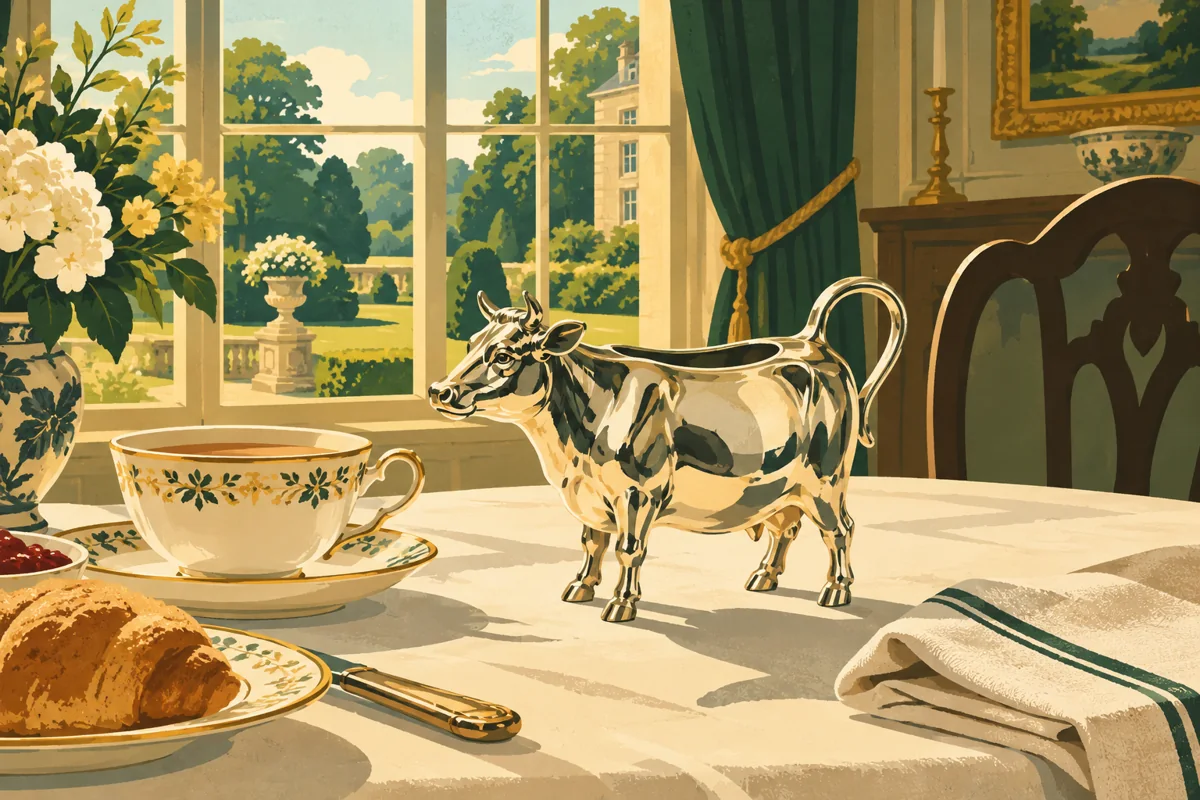
Begin with the cow-creamer pair and keep them together if possible. Their objects and relationships are easier to enjoy when you remember who wants what and which embarrassment has just become somebody else’s bargaining power. This is not a mystery requiring a notebook, but attention to possession matters. An apparently minor object can change significance as it passes between people. The key question is often less “what is this worth?” than “what can somebody make Bertie do because he has it?”
Objects, reputations and pressure
The series rewards watching how material things carry social consequences. A silver ornament is an object of desire, a notebook is dangerous because of what it records, and pearls can produce a crisis in trust. Bertie tends to experience each demand separately. The audience has the advantage of seeing that satisfying one demand may make another impossible. That difference between the small task and the larger situation is a reliable source of tension without requiring a conventional villain in every scene.
There is a second kind of pressure when Jeeves’s continued employment is at issue. Ordinarily Bertie can assume that help is somewhere in the household, even if he has temporarily offended it. Thank You, Jeeves tests that assumption by beginning with a break between them. In viewing terms, pay attention to what changes when advice is no longer automatically available on Bertie’s preferred terms. His relationship with Jeeves becomes a matter of negotiation as well as dependence, and another employer complicates the apparently simple question of who serves whom.
What the source comparisons reveal
Not every difference is an error or a betrayal. The musical instrument that provokes the quarrel in Chuffy is a trombone on television and a banjolele in the novel. That is an identifiable substitution, which can be discussed without guessing why the production made it. The combination of two stories in Pearls Mean Tears is another clear fact about construction. It allows two originally separate predicaments to occupy the same television instalment. The episode notes identify such changes without treating them as evidence of an undocumented production intention.
A useful comparison is to ask whether a change affects the nature of the danger or only its presentation. Changing an instrument retains a conflict over an intolerable hobby. Combining stories changes the rhythm in which problems interrupt one another. Splitting a novel establishes a stopping point that a reader can choose to ignore. These are different operations and should not be collapsed into a single score for “accuracy”. The books and programme can share the same comic foundation while giving the audience a different route through it.
Reading and listening after series two
For a first purchase from this group, we recommend The Code of the Woosters. Read it from the beginning even if the cow-creamer plot is familiar. The narration is part of the attraction, and the book gives each new constraint time to become awkward before another arrives. Thank You, Jeeves is the alternative for readers interested in a temporary rupture of the central partnership. Its period racial language and disguise material also require context; recognising that material is more honest than describing the entire novel as an uncomplicated cosy escape.
If you prefer a shorter commitment, the finale points towards three collections: Carry On, Jeeves, Very Good, Jeeves and The Inimitable Jeeves. Choose by the particular strand you enjoyed, using the table to distinguish a story title from its container. For audio, check whether the listing is a complete reading or a performed adaptation. Both can be enjoyable, but a dramatisation is not the same comparison text as an unabridged reading. Existing book pages provide the buying and listening routes without requiring you to infer the contents from a familiar cover or a performer’s name.
Episode 1: Jeeves Saves the Cow-Creamer
Aunt Dahlia sends Bertie on an apparently modest errand involving a silver cow-creamer. Rival collecting interests turn that errand into something less comfortable, while Gussie’s romantic position brings Spode into the problem. Follow what each person wants from the object rather than assuming its monetary value explains the fuss. Difference from the source’s form: The Code of the Woosters is divided across this episode and the next. This instalment establishes only part of the novel’s interlocking predicament; the television title is not the title of a separate source story.
Episode 2: The Bassetts’ Fancy Dress Ball
Gussie’s attempt to bolster his courage creates a new vulnerability when his private notebook becomes a liability. Stiffy and Stinker have their own matrimonial problem, and Bertie is a convenient person to involve in solving it. The useful viewing question is how many promises one person can make before they conflict. Difference from the source’s form: this episode continues material from The Code of the Woosters rather than adapting a second book. Read it alongside the cow-creamer instalment when comparing structures; the novel does not restart under the episode’s fancy-dress title.
There is also a cross-book borrowing to notice: Gussie’s Mephistopheles costume, associated with the opening courtship business in the novel Right Ho, Jeeves, appears in this television episode based principally on The Code of the Woosters. The source label therefore identifies the main plot rather than claiming that every detail originated in that novel.
Episode 3: Pearls Mean Tears
Aunt Agatha has found another prospective wife for Bertie, and a seaside stay becomes considerably less restful than it sounds. Biffy’s inability to find the woman he loves supplies a second problem with a different emotional emphasis. The pairing makes it worth noticing who wants a marriage and who wants to avoid one. Difference from the sources: Aunt Agatha Takes the Count and The Rummy Affair of Old Biffy are combined here. They belong to The Inimitable Jeeves and Carry On, Jeeves respectively, so neither collection alone contains the complete television arrangement.
Episode 4: Chuffy
Bertie’s musical enthusiasm makes continued life in his flat intolerable to Jeeves. A move towards the country introduces a replacement valet, Chuffy’s financial difficulties and Pauline Stoker’s presence. The important shift is that Bertie can no longer take the usual availability of Jeeves for granted. Difference from Thank You, Jeeves: the offending instrument is a trombone on television, while the novel gives Bertie a banjolele. The quarrel retains its underlying function, but the sound and physical business are changed. Madame Eulalie’s annotations and the episode synopsis establish the two instruments.
Episode 5: Kidnapped!
Bertie’s desire for a club position collides with a duty to assist Pauline Stoker. A journey back towards Chuffnell Regis puts him among people whose interpretations of his behaviour are unlikely to be charitable. This episode includes blackface material; viewers should not mistake the comic premise for a neutral depiction of race. Difference from the source’s presentation: Thank You, Jeeves supplies material for both Chuffy and this episode, while the screen account brings Drones Club members into its musician business. The novel’s minstrel troupe is not that familiar group of Bertie’s club acquaintances.
Episode 6: Wooster with a Wife
Bertie considers marriage and parenthood, but the prospect is tested by the actual demands of being responsible for a child. Tuppy and Bingo also pursue women, generating parallel opportunities for optimistic advice to go wrong. This is a good episode for comparing an attractive general idea with an inconvenient particular experience. Difference from the sources: the instalment combines four stories from three collections, including Bertie Changes His Mind. That printed story is narrated by Jeeves, giving the reader access to a perspective that is structurally different from watching the combined television action.
Broadcast dates and source works
Read the books behind this series
These are the original novels and collections behind the episodes, not TV scripts or tie-in retellings. Check the retailer for the edition, recording, availability and territory.