
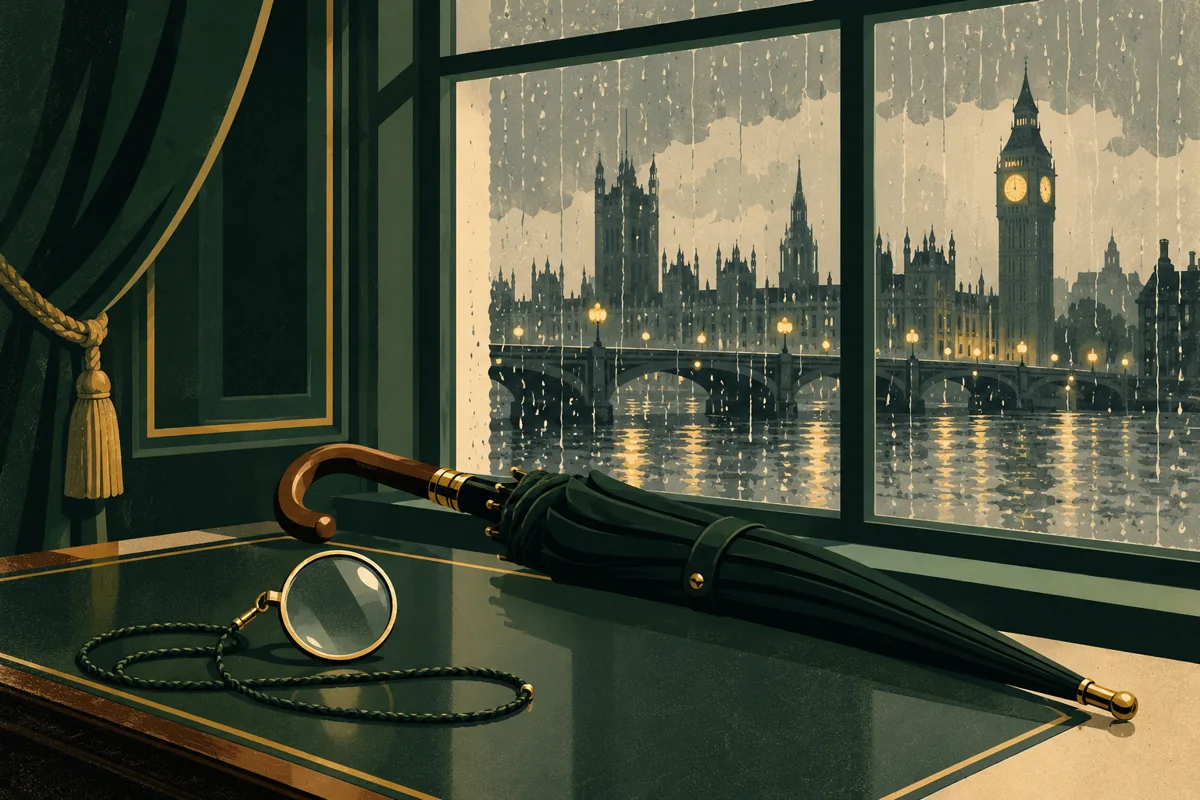
Jeeves: Bertie Wooster’s Valet (Not a Butler)
Jeeves is Bertie Wooster’s valet and the supreme reader of motives, exits and social pressure. His solutions feel inevitable only after everyone else has exhausted the alternatives.
Who they are
Reginald Jeeves first appeared with Bertie Wooster in Extricating Young Gussie in 1915, where the partnership had not yet acquired its later centrality. Jeeves Takes Charge supplies the retrospectively famous account of his arrival in Bertie’s service. Wodehouse found an extraordinary comic arrangement in a young employer who narrates everything and a valet who sees the shape of the problem sooner than his employer. Jeeves’s composure is never mere passivity. He hears a clue, judges a person’s motives and waits for the right moment to introduce a plan.
Calling him a butler misses a recurring distinction: he is Bertie’s personal valet. In Ring for Jeeves, while Bertie is absent, he serves Bill Rowcester and the book takes a different angle on his abilities. That exception belongs on a complete Jeeves book trail without being described as a Bertie-and-Jeeves adventure. Early short stories, longer novels, and a few appearances in mixed collections make a count of “Jeeves books” depend on what one includes. The book links below preserve individual volumes rather than collapsing a later omnibus into a new original adventure.
Personality and relationships
Bertie and Jeeves have a working relationship, but its comic warmth grows from repeated rescues and disagreements. Bertie objects to a sartorial sacrifice or an apparent breach of loyalty, yet keeps finding that Jeeves has understood the social problem at a level he could not. Jeeves has preferences of his own, particularly about clothes and acceptable companions. Their bargain is therefore a negotiation between two people, not an automatic machine for solving plots. Bertie’s kindness makes the work worth doing; Jeeves’s restraint allows Bertie to retain the telling voice.
The Junior Ganymede Club gives Jeeves a professional society and an information network. In Much Obliged, Jeeves, its club book becomes an unusually direct threat to Bertie’s privacy. Aunt Dahlia, Gussie Fink-Nottle, Madeline Bassett and Roderick Spode bring different pressures to the cases. The valet’s solution may help several people at once, or require Bertie to surrender the small prize he had hoped to keep. His knowledge of human vanity is precise, but the stories do not ask us to think he lacks affection.
Best books and memorable moments
Start with Carry On, Jeeves for Jeeves Takes Charge and an assortment of early cases; choose Right Ho, Jeeves if you want a full-length demonstration at Brinkley Court. The Code of the Woosters gives him a tangled Totleigh Towers problem involving a cow-creamer and a notebook. In Thank You, Jeeves, separation tests what the employer and valet are to one another. These are recommendations rather than a fictional timeline. The later books return to familiar people with Wodehouse’s elastic handling of time.
On screen, Stephen Fry played Jeeves opposite Hugh Laurie’s Bertie in ITV’s Jeeves and Wooster (1990–93). The earlier The World of Wooster cast Dennis Price as Jeeves and Ian Carmichael as Bertie. Different performers bring different timing to the same reserve. A screen episode may combine incidents from separate written works, so the printed book remains the authority for a story’s text and the episode’s production record for its cast.
On screen
Stephen Fry played Jeeves in the ITV series Jeeves and Wooster (1990–93), opposite Hugh Laurie. The earlier The World of Wooster cast Dennis Price as Jeeves, as documented by The Wodehouse Society; a television episode can combine several printed stories. Cast and production record. Compare Wodehouse screen, stage and radio versions.
World
He moves between Bertie’s flat, the Junior Ganymede Club and the same country houses in which Bertie becomes entangled. The comedy depends on restraint: a lifted eyebrow can carry an entire critical essay.
Connections
Bertie is employer and beloved problem; the Junior Ganymede book stores professional intelligence; formidable aunts and lovelorn friends provide the cases. Ring for Jeeves temporarily places him with Bill Rowcester while Bertie is away.
First appearance
Jeeves appears briefly in “Extricating Young Gussie” (1915); “Jeeves Takes Charge” became the canonical first-meeting story.
Books in this library
- The Man with Two Left Feet (1917)
- My Man Jeeves (1919)
- The Inimitable Jeeves (1923)
- Carry On, Jeeves (1925)
- Very Good, Jeeves (1930)
- Thank You, Jeeves (1934)
- Right Ho, Jeeves (1934)
- The Code of the Woosters (1938)
- Joy in the Morning (1947)
- The Mating Season (1949)
- Ring for Jeeves (1953)
- Jeeves and the Feudal Spirit (1954)
- Jeeves in the Offing (1960)
- Stiff Upper Lip, Jeeves (1963)
- Much Obliged, Jeeves (1971)
- Aunts Aren't Gentlemen (1974)
- A Few Quick Ones (1959)
- Plum Pie (1966)
- Enter Jeeves (1997)