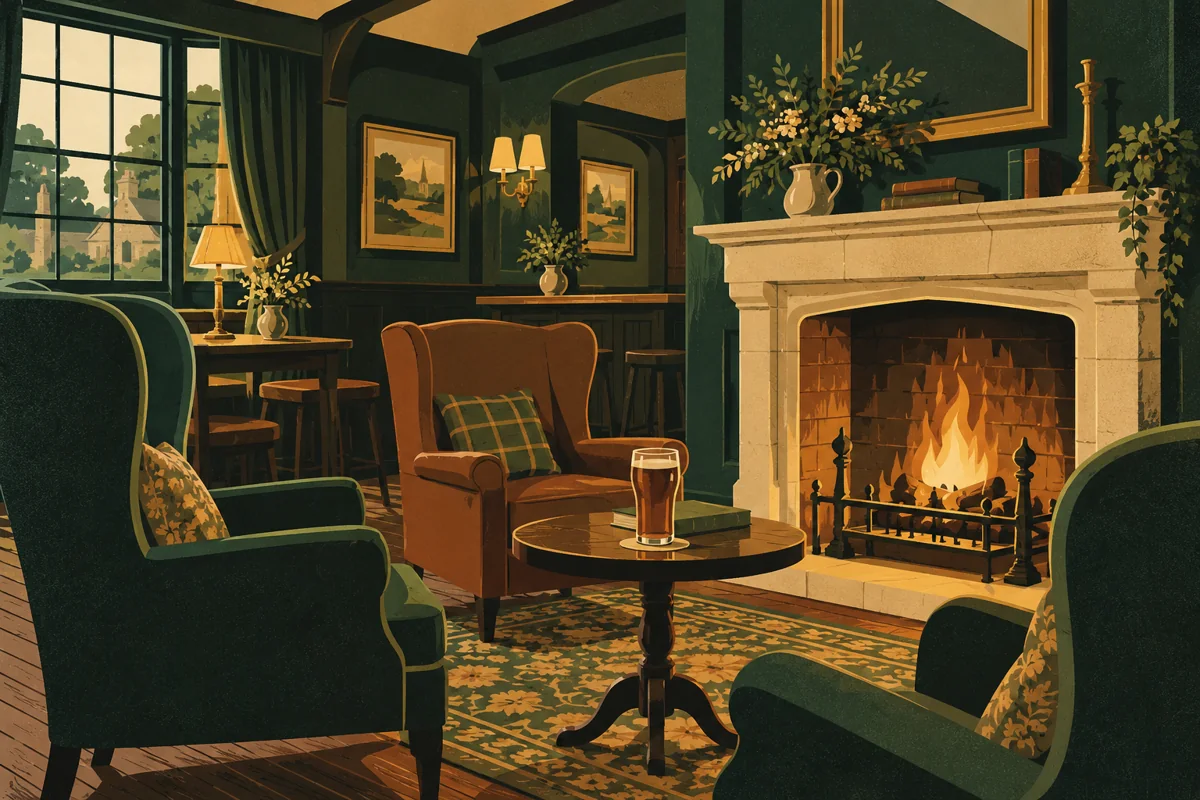
At the Angler’s Rest, Mulliner’s family tales take remarkably elastic turns. These books collect shorter stories, whose first magazine appearances need separate checking.
Another remarkable relation at the Anglers’ Rest
Mr Mulliner presides over the conversation at the Anglers’ Rest with a hot Scotch and lemon and a family connection to an astonishing range of human experience. A visitor’s remark can prompt an account of a nephew, cousin or more distant relation who has met precisely the sort of trouble now under discussion. The pub frame makes the books feel companionable, but the stories travel far beyond the bar: clergymen, photographers, Hollywood people and shy lovers all find themselves drawn into the family history. You can open a collection almost anywhere; the recurring pleasure is to hear how Mulliner turns an ordinary topic into the cue for another improbable relation.
Meet Mr Mulliner is the natural first book. Its nine tales establish the narrator’s method and introduce the pleasure of watching the pub’s listeners make room for one more account. The narrator and his relations are not the same person, a distinction easy to lose in a catalogue that calls every story a Mr Mulliner adventure. Some stories had magazine lives before the 1927 book and gained their Anglers’ Rest frames for collection. An edition’s table of contents and text therefore matter if you are comparing first appearances with the book as Wodehouse assembled it.
Mr Mulliner Speaking adds nine stories in 1929. By this point the premise can carry surprisingly different situations without needing a new explanation each time. A young relation’s romantic obstacle may sit beside a story about a completely different branch of the family. The title promises conversation, and it delivers the pleasure of a confident teller shaping an incident for his audience. Some tales associated with Mulliner have frame changes across magazine and book versions; do not assume that an earlier magazine appearance already named the inn in the form familiar from a later collection.
Mulliner Nights follows in 1933. The third principal book makes the world seem larger again, especially when the film business or a specialised family talent joins the mix. It is not a novel with a single plot running through every chapter. The books are collections of individual tales linked by a storytelling arrangement, so a suggested reading route can be generous. I would still start at Meet Mr Mulliner for the pleasure of learning the house style, then take Speaking and Nights in publication order. If a particular relation catches your fancy, follow that tale first without fear of spoiling a large continuing mystery.
The shelf of three principal volumes is deliberately narrower than a count of every Mulliner story. Later appearances are scattered through Young Men in Spats, Eggs, Beans and Crumpets, A Few Quick Ones and Plum Pie, among other mixed company. American and British selections can differ, and a story may be reframed or retitled. The individual collection guides state the known regional contents. A volume called The World of Mr Mulliner is a later gathering, useful to a reader but not a fourth original book in this three-volume sequence. It may repeat material already owned in earlier collections.
The regular drinkers provide a useful rhythm. They can ask a question, offer a general opinion or simply give the raconteur a reason to reveal a new branch of his family. The Anglers’ Rest is therefore more than a label on a set of stories: it is a way of turning an anthology into an evening’s conversation. Wodehouse can send the action to a country house or Hollywood and still bring the telling voice back to the pub. When an edition changes a frame, the reader feels a small change in the story’s social setting even if the central comic episode survives.
For a first taste, try one of the opening tales in Meet Mr Mulliner and then follow the nine-story collection. For a quick comparison, read a later volume next and notice how readily the narrator accommodates a new setting. Publication order makes a tidy home shelf, yet it is no rule that a story in Nights will be incomprehensible before every story in Speaking. The book guides list stories and sources, while the mixed collection shelf helps find later relations. Use those links to avoid buying a later omnibus under the impression that it contains wholly new material.
The Wodehouse Society lists Wodehouse Playhouse, a television series of 1975–78 that adapted short stories, including work from Mulliner’s world. Episode plots and casts need to be attached to the precise source tale before a page claims that one book became one episode. An audio production also needs its format named: a full-cast dramatisation can be a delightful new performance without being an unabridged recording of the printed collection. For now the three book records are the surest map back to the stories. The man at the Anglers’ Rest would, I suspect, approve of beginning with a glass and allowing the first relation to introduce the next.
There is a small bibliographical joke in a family tree that seems to expand whenever the speaker needs one more example. Counting named relations is less useful than keeping track of the actual story one is reading. The first three volumes offer a practical core collection; the later mixed books and omnibus volumes are paths outward. If a listing says complete, compare its contents against the original volumes and the scattered stories before assuming it settles every question of variants and frames.
Where to begin
Meet Mr Mulliner: choose a longer narrative or a shorter entrance according to your mood. The original book details and regional titles are on each guide.
Suggested reading route
 Meet Mr Mulliner1927
 — Nine tales establish the raconteur and his far-flung relations.
 Mr Mulliner Speaking1929 — Nine further stories let the family history expand.
 Mulliner Nights1933 — A third collection brings still more relations and settings.
Publication-order book guides
- Meet Mr Mulliner1927 (1927) — Nine tales establish the raconteur and his far-flung relations.
- Mr Mulliner Speaking1929 (1929) — Nine further stories let the family history expand.
- Mulliner Nights1933 (1933) — A third collection brings still more relations and settings.
People to meet
- Mr Mulliner — Another hot Scotch and lemon, please
On screen and radio
The Wodehouse Society documents Wodehouse Playhouse (1975–78), a short-story television series including Mulliner material; consult episode records before tying a performance to a particular tale. Wodehouse Society adaptation records.
Recorded crossovers
 Blandings Castle and Elsewhere1935 — catalogued primarily with Blandings Castle, with a verified Mr Mulliner connection.