Places in P. G. Wodehouse’s books
A Wodehouse address often tells you what sort of trouble is about to arrive. A castle invites aunts and impostors; a club allows a friend to volunteer you for a task; a suburban house gives a romantic misunderstanding ample room. This guide follows eight fictional places as they work in the stories. They are literary settings, not tourist directions.
How to use this map
Wodehouse’s worlds overlap, but the geography is not a modern atlas with a single authoritative pin for every gate. A later novel may revise a detail or a US edition may use another name. Where an identifiable regional variant matters, it belongs beside the book rather than being silently ironed out. The links below go to the best book for meeting each place; the series shelves show the broader routes. Readers who enjoy tracing a real-world inspiration can consult specialist scholarship separately, but this page keeps its attention on the fictional location and its job in the comedy.
Blandings Castle
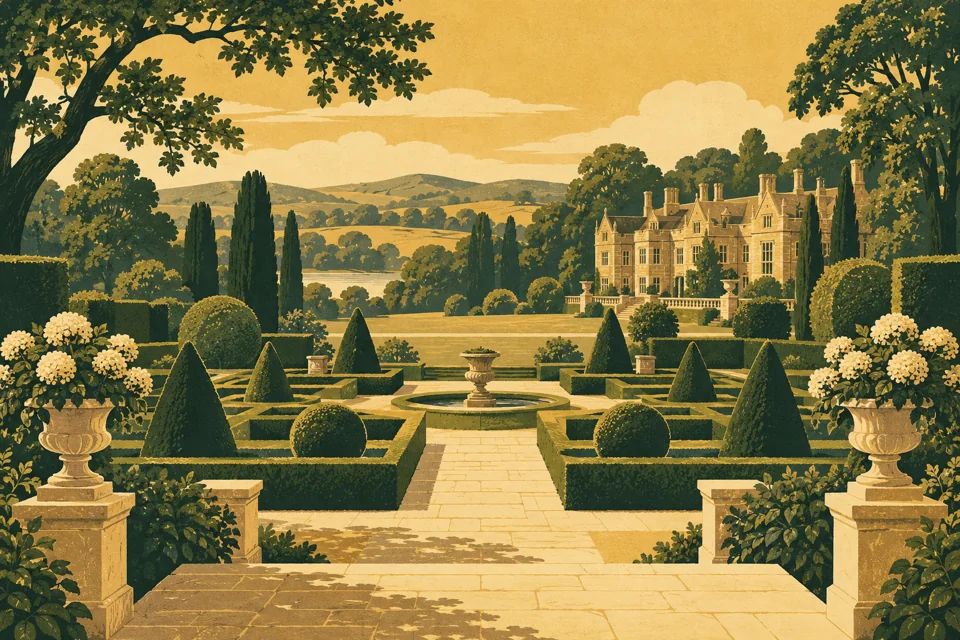
Lord Emsworth would prefer to think about his garden and, later, the Empress. At Blandings Castle, other people require him to consider jewellery, marriage, publishers, efficient secretaries and the order of an entire household. The estate is a wonderfully elastic stage: a visitor can enter with a mistaken identity while a resident fails to notice what everyone else sees. Start with Something Fresh, where the stolen scarab gives the household its first sustained book-length scramble, and follow the Blandings shelf through later novels and stories.
The setting is invented. Specialist notes discuss possible real inspirations, including Sudeley Castle and Weston Park, without making either estate identical to the fictional castle. That distinction preserves the pleasure of Wodehouse’s design. In Leave It to Psmith, a crossover visitor can arrive here from another book-world; in Heavy Weather, the estate’s human and porcine priorities collide again. Blandings Castle annotations discuss the geography and its proposed models.
Market Blandings
The town near Blandings gives the castle a practical connection to the outside world. Arrivals, railway journeys and errands can be measured against it; a country-house comedy still needs a place where an inconvenient person can appear. It is easy to treat the name as a throwaway signpost, but the town helps establish how a newcomer reaches Emsworth’s orbit. Leave It to Psmith and Uncle Fred in the Springtime make excellent companion stops.
Do not confuse Market Blandings with Market Snodsbury, the town associated with Aunt Dahlia’s Brinkley Court and Gussie’s prize-giving. The similar “Market” form is a comic country-house convenience, not a licence to merge the estates. The Uncle Fred annotations discuss journeys to Market Blandings and the castle’s fictional neighbourhood.
Brinkley Court
Aunt Dahlia’s home is one of the central places of Bertie’s life. The welcome may be affectionate, but a summons can still place him in the middle of a meal, a romance or a piece of tactical aunt-work from which he would have preferred to remain detached. Anatole’s cooking gives Bertie a very good reason to return even when his instinct advises escape. Right Ho, Jeeves is the great first visit: Bertie’s self-appointed solutions and Gussie’s public ordeal make the house into an engine of escalating obligations.
The American edition of Right Ho, Jeeves was titled Brinkley Manor, and specialist annotations say the house itself was called Brinkley Manor there. The book and setting names thus need an edition label; “Manor” should not be presented as an unrelated second house. Wodehouse places Brinkley Court in Worcestershire. The book annotations record the regional naming difference. The later Jeeves and the Feudal Spirit returns to Aunt Dahlia’s household.
Totleigh Towers
Sir Watkyn Bassett’s country house is where Bertie’s difficulties can become almost architectural. Rooms, corridors, bedrooms and borrowed property matter because a person carrying the wrong object may meet precisely the wrong host. The Code of the Woosters is the essential first book: the cow-creamer, Madeline Bassett and Roderick Spode give Bertie several excellent reasons to wish himself elsewhere. The house recurs in Stiff Upper Lip, Jeeves, where old associations make a new visit no less hazardous.
Totleigh is a fictional house, and its recurring people are often more useful landmarks than a claimed real-world model. The Code annotations help locate references across books. If a stage or television adaptation rearranges the rooms, that is a production’s staging decision; the adaptations guide identifies the related works rather than mapping a prop back onto a supposedly fixed floor plan.
Steeple Bumpleigh
For Bertie, this village has the fatal drawback of containing Aunt Agatha and Lord Worplesdon’s Bumpleigh Hall. Joy in the Morning makes his attempts to do a good turn there increasingly intricate. A village can look serene in a sentence while the social obligations gathered inside its buildings make it much less relaxing than an afternoon in London. The contrast between a peaceful name and an aunt’s capacity for instruction is an old Wodehouse delight.
Steeple Bumpleigh is placed in Essex in the later book references. The nearby cottage Wee Nooke belongs to the fictional arrangement of Joy in the Morning; it should not be sent to a real tourist map. The Aunts Aren’t Gentlemen annotations trace that cottage back to the earlier Jeeves novel. The spelling of the village is Bumpleigh; a retailer or adaptation summary can introduce an error, so check the book record.
The Drones Club
The Drones is a recurring London club of younger men, where reputations are built from wagers, impulsive undertakings and the stories afterwards told about them. Bertie’s friends can enlist his assistance there, while a Drones Club tale can introduce a different young man altogether. It is therefore a social crossroads rather than one book’s exclusive location. The Freddie Widgeon and Barmy Fotheringay-Phipps trails lead into its varied company; Young Men in Spats gathers related stories.
A comic club also solves a narrative problem. Someone can hear an incredible account from a fellow member without the writer pretending that every story needs the same narrator. The name does not refer to an actual members’ institution to which a present-day reader can apply. Later literary homages may give it new purposes; use Wodehouse’s books to establish its original role, and keep the continuations separately attributed.
The Junior Ganymede
Jeeves’s club belongs to the world of valets and butlers rather than Bertie’s Drones. Its most consequential possession in the Jeeves books is the private record kept of employers. That reversal is very satisfying: the seemingly unobservant gentleman may discover that the people who actually run his household have observed everything. Much Obliged, Jeeves is a useful book route for the club’s book, while the Jeeves profile gives the wider character trail.
It is tempting to infer a complete real-world constitution or a single street address from every passing club reference. The original stories use the institution for a comic and social purpose. Ben Schott’s later King of Clubs gives the club a new espionage role; that belongs to a modern authorised homage, not an original Wodehouse fact. The Wodehouse Society’s resources offer a route to more detailed character and setting scholarship.
Valley Fields
Valley Fields is the invented south London suburb in several Wodehouse books, with gardens, homes, local expectations and all the opportunities for people to get in one another’s way. Sam the Sudden is a particularly good visit; Ice in the Bedroom revisits a related neighbourhood and reworks some story machinery. These are separate novels, and a shared or similar locality does not make the later book a simple reprint.
Wodehouse himself called Valley Fields a thin disguise for Dulwich in the preface to Sam the Sudden, according to the specialist book annotations. The biographical connection enriches the reading, but this page is about the fictional suburb on the page. It is not a claim that every character’s house can be located at a surviving Dulwich address. The Life guide discusses Wodehouse’s own school years separately.
Where the routes meet
Start a country-house journey at Blandings, move to Brinkley Court for Bertie’s great attempted rescue, and then visit Totleigh Towers if you can bear his continued proximity to Sir Watkyn. For a change of scale, follow the club stories into London or visit Valley Fields for a suburban farce. These are reader routes, not a proposed chronology of all the fictional events. The names help the mind shelve the stories; they never replace a book’s own opening and its particular cast.