
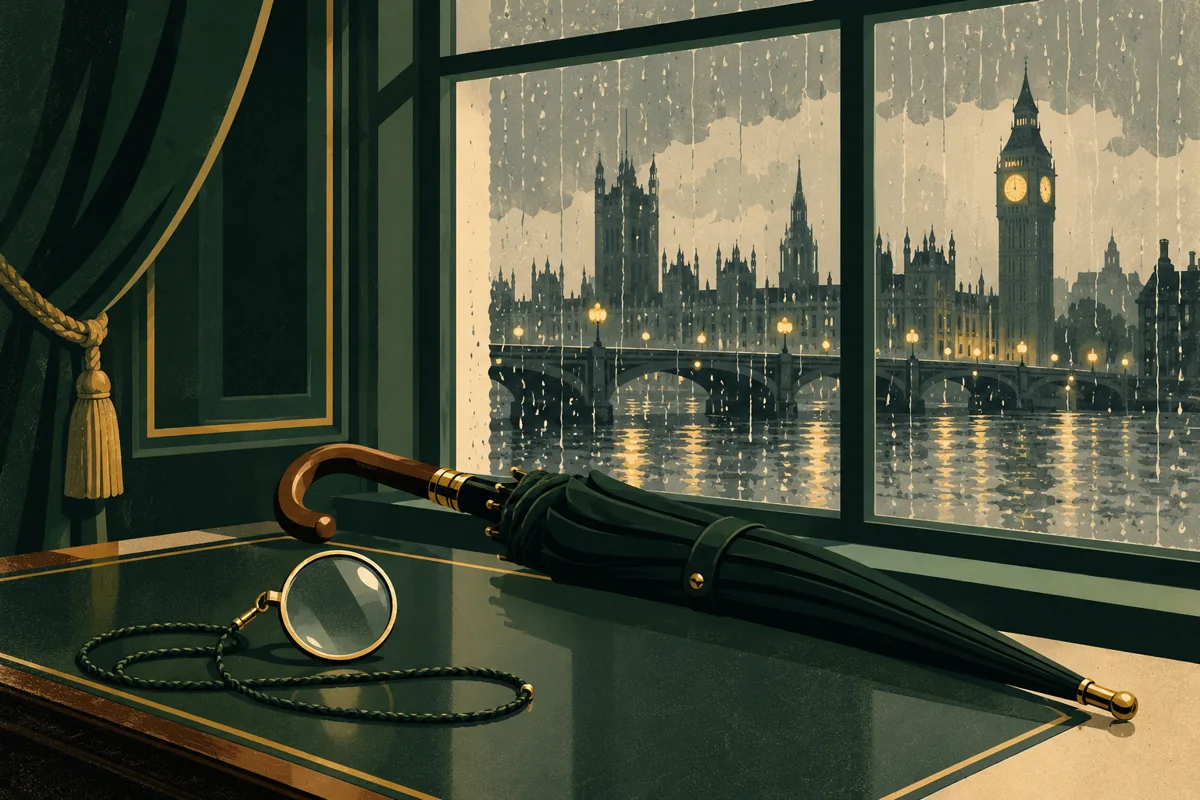
Uncle Fred
Frederick Altamont Cornwallis Twistleton, fifth Earl of Ickenham, regards a quiet afternoon as raw material for impersonation, intervention and benevolent chaos.
Who they are
Frederick Altamont Cornwallis Twistleton, fifth Earl of Ickenham, enters the written record in “Uncle Fred Flits By,” first published in 1935 and collected in Young Men in Spats. His benign view of himself and the alarm he causes other people are both necessary to the comedy. He sees a stranger’s difficulty and imagines a happier arrangement; a spare identity, an unexpected visit and Pongo’s assistance soon make the arrangement much harder to escape. For a reader, the pleasure is partly watching an apparently impossible improvisation acquire a curious momentum.
The title Uncle Fred can make him sound like a harmless adviser in an armchair. He is almost the opposite: a man with an active belief that one should go out into the world and give it a story. Unlike a conventional confidence trickster, he generally wants other people to prosper. Their consent to the method arrives late, if at all. Wodehouse lets us enjoy the audacity without requiring us to pretend that every plan would be pleasant to inhabit. The joke depends on the gap between Fred’s certainty and a sane person’s anticipation of consequences.
Personality and relationships
Pongo Twistleton is the nephew who knows too much about his uncle’s habits to be reassured by a genial greeting. His objections make Fred’s courage visible, while his loyalty ensures that the plot can proceed. Lady Ickenham’s attempts at restraint usually take place at a distance. In Uncle Fred in the Springtime and Service with a Smile, the adventure passes through Blandings Castle, where Lord Emsworth’s peace is already vulnerable to visiting schemes. The crossing joins two established comic worlds rather than turning every Blandings story into an Uncle Fred volume.
Each new host household gives Fred a chance to test the rules of respectable behaviour. A relative may fear disgrace, a younger lover may need a nudge, and a friend may be startled to find an unknown gentleman speaking with total authority. The Earl’s aristocratic title is useful because it makes his lack of reverence for other people’s status still funnier. One can cheer a rescue and still side with Pongo during the seconds before the full shape of it has been explained.
Best books and memorable moments
Read “Uncle Fred Flits By” in Young Men in Spats for the short form, then Uncle Fred in the Springtime for a substantial Blandings crossover. Uncle Dynamite and Cocktail Time give him other households to rearrange; Service with a Smile takes him back to the castle. The five works do not need an invented fictional calendar. Their original book editions and any cross-shelf classification are explained in the linked guides. A later omnibus is a convenient reading copy, not a sixth original adventure.
Adaptations of Wodehouse exist in several media, but this page leaves a named Uncle Fred performer unassigned until a specific role and production can be supported by a reliable cast record. The books supply enough theatricality. I would start with the story and notice how quickly Pongo’s private knowledge turns a genial arrival into a warning signal.
On screen
A specific performer is not assigned to Uncle Fred here without a verified production and role credit. Cast and production record. Compare Wodehouse screen, stage and radio versions.
World
Uncle Fred’s plots are powered by nerve and an almost mystical certainty that life should be improved immediately. Other people supply houses, names and consequences.
Connections
Pongo Twistleton is his nephew and unwilling lieutenant; Lady Ickenham attempts distant restraint; Blandings hosts two of his five canonical adventures.
First appearance
He debuts in “Uncle Fred Flits By” (1935), collected in Young Men in Spats.
Books in this library
- Young Men in Spats (1936)
- Uncle Fred in the Springtime (1939)
- Uncle Dynamite (1948)
- Cocktail Time (1958)
- Service with a Smile (1962)